Showing posts with label Czech. Show all posts

Saturday, 1 September 2012

The Posh Side of Prague

Many tourists go to Prague for stag dos and cheap pivo, however, there is a chic side to the Czech capital. When our Tasmanian friends came to visit, we decided this would be the perfect excuse to check out all those fancy places we had walked past and read about, but not tried out yet.

We found the hotel Pure White online and made a reservation through www.bookings.com, as reserving through the hotel website was not that straight forward. The photos of the hotel looked great and when we arrived we were not disappointed. The entrance and reception area is stunning and the rooms are modern and tasteful with some nice touches.

Double room at Pure White

Toilet and wet room with rain shower

The best thing about Pure White is the price; for a 4 star stay, €53 a night is excellent value.

Once we had checked in and freshened up, we decided to head into the centre of Prague. First stop was the beautiful Zdenek's Oyster Bar. I had walked past this little place, tucked into a side street, not far from Staroměstské náměstí (Old Town Square), on a previous trip. The bright Veuve Clicquot parasols caught my eye and I knew I had to come back and try it some time.
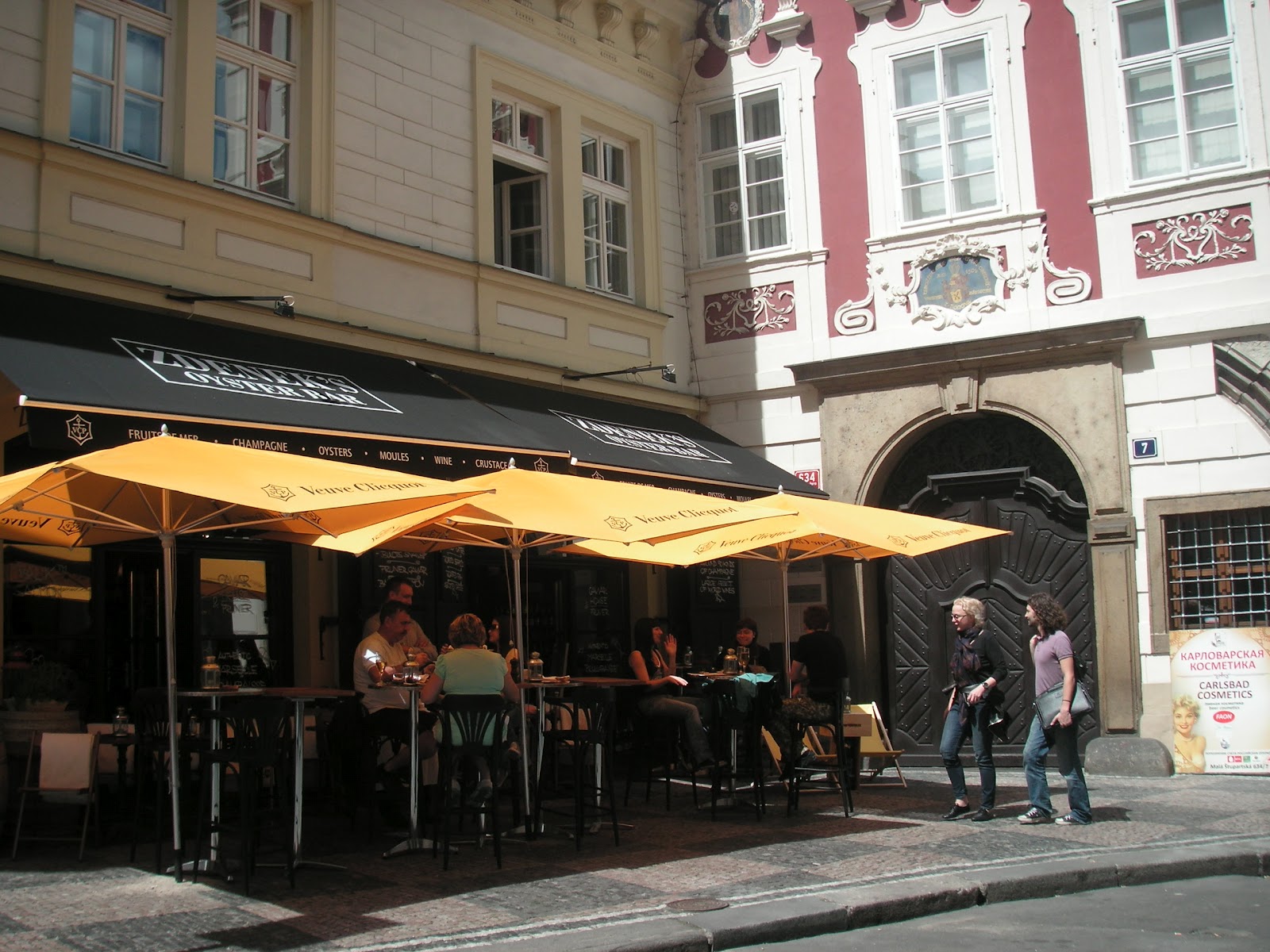

At night, the interior of the bar is simply gorgeous. I'll let the photos speak for themselves.


I was a bit dubious about having seafood in Prague. After all, the sea is a long way away. However, our Australian friends were happy with their Marennes oysters and my shrimp and prawn platter was very fresh and much bigger than expected for the price. We each had a glass of 2004 Veuve Clicquot, which was served with complimentary caviar.


We left the sultry interior of Zdenek's Oyster Bar for another dimly lit establishment: Hemingway Bar. This cocktail bar only opened about a year ago and as you can probably guess is decorated with photos of American writer Ernest Hemingway. Upon stepping inside you feel as though you are entering a gentlemen's club (not of the Spearmint Rhino variety, but the old fashioned London variety); there are leather sofas, book cases and lots of dark wood.

The cocktail menu has some classics, but also a good list of house cocktails that I had never tried before. I went for the "Walk in the Clouds". The pink pepper on the top and the white chocolate syrup made it really unusual, yet delicious. My OH had a "Hemingway's New Fashioned", which comes in a small bottle inside a book!


Many more cocktails ensued, naturally. Well, with the bar being open till 1am, it would have been rude not to, wouldn't it?

Cherry Julep

 Apricot  and White Chocolate Caipirinha and Six Fingers Cat

It was great to have a little luxury for an evening and better still, it cost us a fraction of the price it would have done in London or Hobart. 

Sunday, 17 June 2012

Discovering South Moravia

Znojmo is not a place I had heard of before going there. The DK Eyewitness Travel Guide only deems it worthy of a few lines and doesn't go into any detail about what you will find when you get there. However, I am really glad that I made the trip. One of the 3 most important Moravian towns along with Brno and Olomouc, Znojmo has a wealth of baroque buildings, squares and churches along with what has to be one of the most breathtaking valley views I have seen in a long time.

We booked on to a day trip run by the Brno Expat Centre. The day didn't go according to plan, as 4 people dropped out of the tour at the last minute, meaning that the mini bus hire was no longer viable. Undeterred, 6 of us, lead by our Czech organiser and guide, decided to take the public bus. We just managed to get on board before it reached full capacity. We spent the scorching hot day enjoying the sights of the ancient town.

Before reaching the old town, there is a Parisian style roundabout with grandiose buildings dating from the mid-19th century.
Old Town Hall

Inside the underground labyrinth, dating from medieval times.
Fine if you are small like me, not so good if you are tall like him! It was interesting to go down,
but the tour was a little naff what with fake skeletons and goblins!

The intrepid day-trippers head through the back streets 

Inside the Gothic Cathedral of St Nicholas lies St. Boniface in all his finery

Incredible globe pulpit

Cathedral of St. Nicholas with neighbouring two-tier chapel

Dyje river

Tuesday, 22 May 2012

I feel it in my fingers, I feel it in my toes...

...language is all around me and so the feeling grows.

As a non-native speaker of a language, how do you know if what you are saying or writing is correct or not? Do you base it simply on what your text or grammar book says or does it go beyond that into the realms of instinct or gut feeling?


Ever since I first started learning languages at the age of 11, I have relied heavily on gut instinct. I think this is mainly out of laziness. I have never been keen on learning grammar and I was lucky enough to be able to feel what was right. After 20 years of learning French and German, (I am always learning, it didn't stop when my BA did) I find myself wondering how much of what I now say and write is based on instinct. 

At the moment I am writing a lot of German, perhaps more than I ever have. My grammar is somewhat rusty, as I haven't used it in a business context for 5 years, but when I write a sentence I can often feel whether it is right or not. If I am unsure, I google it, but more often than not my initial feeling was correct. Where does this come from? Is it some long lost grammar memory tucked at the back of my brain or is it an inbuilt sense of the language and how it should be?

I find that French is easier to use based on gut feeling. Perhaps because the grammar is less complex than German - no cases, fewer genders, no declension. French has a lyricism to it, a musical quality that I can feel. German is more rigid, harsher, but also more amusing. I wrote in a previous post about how comedy can play a role in language learning.


How can instinct come into play in a brand new language, where the grammar is unknown? It has been interesting for me to learn Czech. I can rely somewhat on the German grammar I know, but as for the vocabulary, that is completely different. Interestingly, my teacher gave me a list of adjectives and asked me to guess what they might mean. The first one I guessed correctly. Now, this could have been sheer coincidence, but when I looked at the word, something inside me told me what it meant. It felt right - the sound of the word somehow resonated with me.

I believe it is possible to have an instinct about language use, even if it is not your native tongue. Too many learners get caught up in all the grammar and rules. Language is constantly moving, flowing, adapting. If you bind it too tight it suffocates and you constrict and freeze with it. I encourage everyone to open their minds and start feeling, breathing, absorbing the language. You might just surprise yourself.

Tuesday, 27 March 2012

Making sense of Czech

What have comedian Vic Reeves, golfer Nick Faldo and time traveller Dr Who got to do with language learning? Well, if you are me, then they are just some of the funny ways I manage to learn new vocabulary.

My fascination with words, how they sound and the images they conjure up started when I was quite young. I remember certain ordinary sentences could create pictures in my head that had very little to do with the original sentence. Words took me on a journey in my mind. When I was about 7, I decided each letter could only be used once in a sentence and thereby created some bizarre phrases!

Vic and Bob are stored under "mirthfulness".

When I started to learn French and German at the age of 11, these skills came in handy. Much of language learning is about making sense of something that at first makes no sense at all. It's about making links and going beyond everyday comprehension to reach understanding. At school, my classmates would ask if I had swallowed a French dictionary, as I often knew the meaning of words that we had not learnt. However, I don't believe you need to be taught a word to understand it. If you can find some commonality with your own language, then you can work it out.

This can work quite well in some instances, but what if the word is nothing like the English word? What if no matter how long you stare at it, it just doesn't hold any meaning for you? This is where the imagination comes into play.

When I was 17, I decided to learn the whole GCSE Spanish syllabus in one year. No mean feat and it inevitably involved memorising reams of vocabulary. If I can find something amusing about a word, it is far more likely to stick in my head. Some words just sound amusing, others remind you of something funny in your own language and others do not. Take the Spanish word for "skirt" una falda. Not a titter. Yet, imagine Nick Faldo, playing golf, wearing a skirt. Pretty amusing (to my 17 year old brain, anyway). And so, when I want to remember the Spanish word for skirt, this image of the golfer comes into my head and I remember that the word is linked with his surname.

Unfortunately, not wearing a skirt, just ordinary plus fours.

And so, at the age of 31, I am embarking on the task of learning a totally alien language: Czech. I don't know any other slavic languages, so I have nothing else to lean on linguistically. Luckily, I still have my imagination! I'm pleased to say it has not dwindled over the years and I am still fascinated by words and finding some sort of connection to aid understanding, no matter how tenuous.

During the last few Czech lessons, I have been reminded more and more of one of my favourite UK TV shows from when I was 16 (it recently made a brief comeback): Shooting Stars. This zany, frankly ridiculous BBC comedy game show always had me laughing out loud. One of my favourite bits was "Iranu! Uvavu!". To my ear, quite a few Czech words sound like these nonsensical Vic Reeves creations and I always have to stifle a laugh. Last week I was learning directions, which included vlevo and vpravo (left and right). Now, don't they sound a bit like iranu and uvavu?


I was even more amused when I learnt the word for "far": daleko. Ha! Even Dr Who is getting in on the Czech language action now! I can just imagine Daleks cruising around speaking Czech. The rolling "r" would make for perfect Dalek speak, too. To je Doktorrrr! Vy-hla-dit!!!


Lots of words have stayed with me, even though they are not every day words, just because I like the sound of them. Igel (hedgehog), Eichhoernchen (squirrel) and Schwarzwaelderkirschtorte (Black Forest Gateau) are some of my German favourites. I also still remember the Luxemburgish word Gromperen (potatoes) from a shopping trip I did in the little Grand Duchy and Hungarian boldog születésnapot (happy birthday) from a card I wrote to a colleague. All of these words bring a smile to my face and are what keep me engaged with language learning.

Vintage images courtesy of http://graphicsfairy.blogspot.com

Saturday, 25 February 2012

On yer bike!

Once you have a skill, you can't really remember not having that skill. For example, can you remember what it was like to not be able to ride a bike? I'm not talking about learning to ride the bike, but the time before that when you weren't able to do it at all. It's impossible. For me, speaking a foreign language is the same as riding a bike. Once you get on and start pedalling it can take you anywhere you want to go.
At the moment my most hated phrase is Nemluvím česky "I don't speak Czech". Every time I go into a shop and the assistant comes over to me and starts speaking, I have to smile apologetically and say the dreaded Nemluvím česky. This is followed by my second most hated phrase Mluvíte anglicky? "Do you speak English?". I suppose for many people these would be the usual phrases they would use when abroad, but for me, as a linguist, it brings up all sorts of unpleasant feelings and thoughts:

  1. How arrogant to be in a foreign country and expect the inhabitants to speak English! 
  2. How unacceptable not to be able to say anything in their language back to them!
  3. I speak 2 other languages fluently and another one conversationally - I hate not being able to say even basic things in Czech! 
  4. They must think I am so rude and stupid!
  5. I just should be able to speak Czech!

I realise that most of the above thoughts are irrational. I have only been in the Czech Republic for a month and during that time I have had to do a lot of admin (endless hours on the phone to French bankers, removal firms etc) and I couldn't prepare myself and learn any Czech before I moved here, as we only found out last minute that my partner had been offered a job here. I have also found it very difficult to find a teacher for intensive day-time lessons. So, all in all, not being able to speak the language is not my fault.

I also mainly get positive reactions when I use Mluvíte anglicky? and some people seem quite pleased to be able to use their English with me. Those that don't speak English smile politely and leave me alone. I only had one bad experience, when the counter clerk in an office got annoyed that I couldn't speak Czech and started banging the desk saying "Český! Český!" BUT, I still don't feel that it's right to expect other people to speak English to me.

Apparently, this is not the typical expat way of thinking. Last night I was in a pub with a group of people from all over the world. It was great to talk to Germans, Russians, Romanians, Americans - you name it, they were there. I struck up a conversation with a Czech guy. When I told him about my feelings about not being able to speak Czech, he said this was the first time he had heard this in his whole life from an expat (and especially a British one) and was amazed and pleased to hear that I didn't expect everyone to speak to me in English and that I was keen to learn Czech. When I told the German guy that I was planning on learning Czech, he said "But why? You don't need it!" Why do many expats think this? To me, it's like turning up at a house party without a bottle. Sure, you can drink other people's drinks for a while, but soon they will get fed up with you and tell you "On yer bike, mate!". And rightly so.

I am really lucky in that where I am going to work in a month's time, Czech lessons are provided for free. However, I still want to learn as much Czech as I can before April, so I have signed myself up for intensive Czech lessons. Eight hours a week for the next four weeks. I'm really looking forward to it. I hope that pretty soon, Nemluvím česky will become a thing of the past.

Thursday, 2 February 2012

The tangerine of friendship


I walk into the shoe repairer's. Well, I wasn't sure from the outside that it was a shoe repairer's as many shops (and even bars and restaurants) here don't have windows and it is a surprise as to what you will find once you open the door! The only thing I had going for me was that I had found out that opravy obuvy meant shoe repairs. *Kling-a-ling-a-ling* Ah yes, some keys, an old sewing machine: I am in the cobbler's! "Dobry den!" I take my boots out of my backpack and point to the cracked sole and make a miserable face. The round faced cobbler looks horrified and draws around the crack with a piece of chalk. Then the fun begins. I can't understand a word he is saying. This is very frustrating for me, because as a linguist, I am used to speaking other languages fluently. Czech just wasn't on the curriculum. "Er, mluvíte anglicky?", "Ne". "Sprechen Sie Deutsch?" This one can sometimes yield very good results. *Kling-a-ling-a-ling* Response: "Ne". Oh dear. Man who has just walked in says "Ich spreche Deutsch" Hurrah! So, we have a three-way conversation in German and Czech and I find out that I can pick my boots up on Wednesday.

I pop back in later that week and my boots are all fixed with nice grippy soles (very important here what with all the snow and ice). "Dobry, dobry!" I say and smile. Then, the cobbler trys to make conversation with me, but he knows I don't speak Czech. A lot of miming ensues and the odd word from my Czech phrasebook. But, I manage to find out that he is Armenian, came here 16 years ago, speaks Czech, Armenian and Russian (no common languages there then) and likes to do "fitness" after work. He shows me a comical photo of a body builder to demonstrate this! This is my first interaction with a Czech person in my village in Czech and although it was really difficult, we got there in the end. As I go to leave he takes out a bag of tangerines and offers me one. I gesture "No, I'm fine thanks", but he insists. So, I put the little fruit in my backpack. As I leave I feel really touched by this offering. We didn't have many words to communicate with each other, but the tangerine said it all: I have made my first Czech friend.